108 Second Semester The Main Pillar – Cheng Chu Weng Solo Exhibition
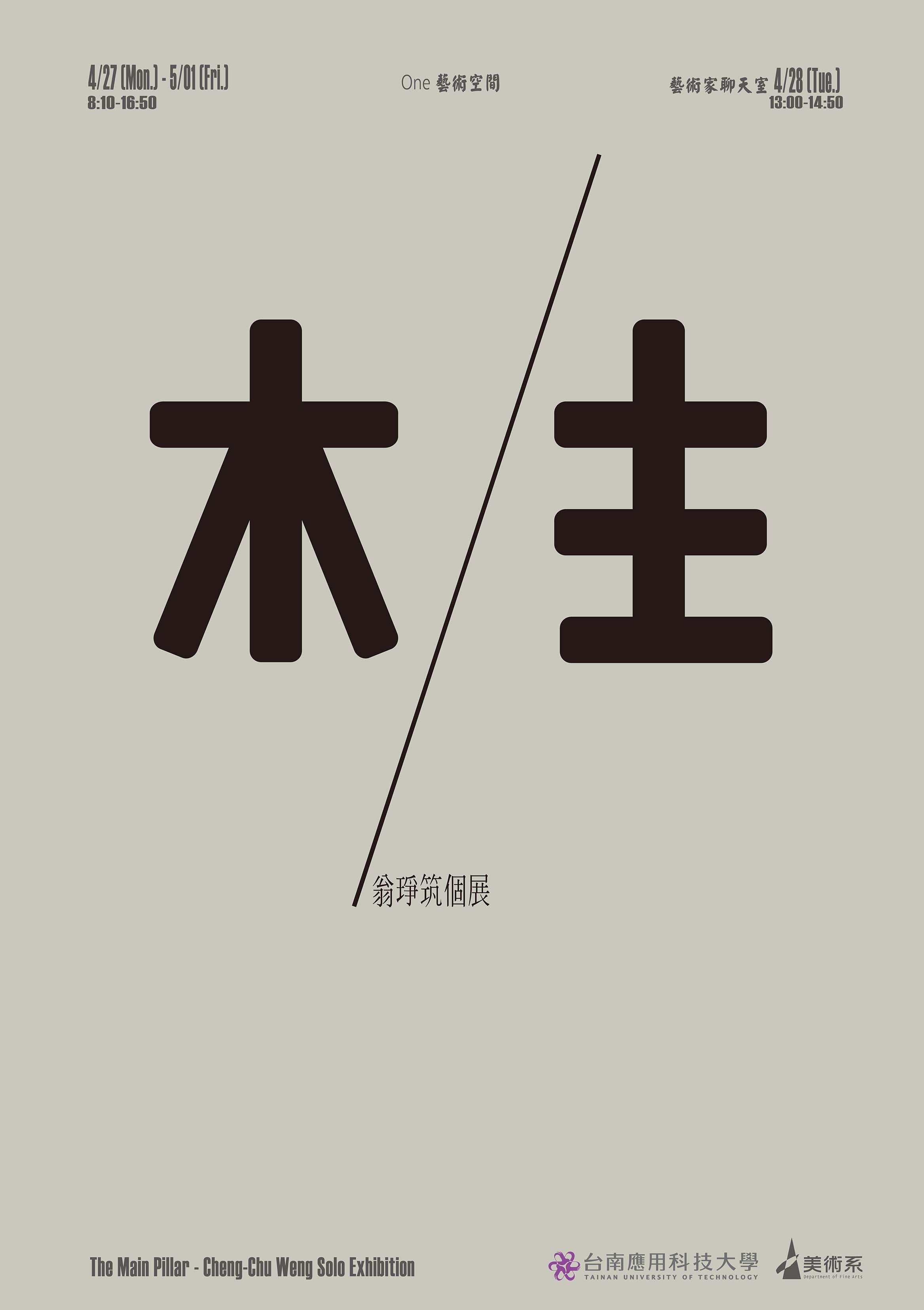
108學年度第二學期《藝術家聊天室》木/主-翁琤筑個展
在東西方建築中,柱子不僅是作為水平受力支撐亦體現該空間之精神性。例如,和室建築裡的天地
柱(日文:大黑柱)或稱精神柱。而在迴廊裡的柱子則是負空間的展現。由此,人們可以看見建築師應
用可見的形象來體現無形的現象。此概念與創作者長期的實踐-擴張繪畫並置。兩者亦對於無形的現象
的關注而「凝聚」則是兩者所呈現的效應。
木/主-翁琤筑個展體現創作者對於One藝術空間的觀察,創作者試圖體現該空間的奇異結構,
尤其是該空間的三根柱子。它們的功能性與精神性令人質疑,此模糊關係引起創作者的興趣。這三根柱
子與該空間的關係似乎與和室建築裡的天地柱呈現互文關係。在創作者的詮釋下,該空間本身體現台灣
之多元文化的特性,西式的曲面牆與中式的圓柱或者可視為日式的建築中的精神柱之組合。此東西方文
化融合亦可於創作者的實踐-擴張繪畫中看見。木/主與創作者其他作品一樣產生「模糊的結構」之效
果。精神柱放置於柱子之間來試圖模糊原有柱子的結構。此外,當人們經過作品時,娟布就會飄動起
來,這種現象提升人們對於柱子與柱子之間,柱子與該空間之間的身體感意識。如同此作品/展覽名稱
「木/主」,即體現「柱」之功能性的瓦解與主客題的模糊不清。
擴張繪畫是通過考慮物件與空間本身和身體於該空間的不同意識並應用繪畫元素/媒體來創作。作
品的尺寸範圍從如同小標點般的大小至大型到充滿整個空間。該研究把實踐置於當前藝術理論和歷史的
爭論中,以及後結構主義和現象學的哲學框架之內。此外,擴張繪畫提供一個新的“擴張領域的繪
畫” 觀點,而這種觀點要比現代和後現代的辯論更為廣泛,再者考慮將繪畫視為一種有關行為的當前
實踐,它與「神化起源」有關。擴張繪畫通過創作和思考表達出來,繪畫,因此成為思考和創作的模
組。
The Main Pillar – Cheng Chu Weng Solo Exhibition
Time: 4/27 (Mon.) - 5/01 (Fri.) 8:10-16:50
Location: One Art Space
Artist Talks time 4/28 (Tue.) 13:00-14:50
Pillars not only support of building but also present the spirit of the space. For example, dai koku bashira (Japanese, the main pillar) or called spiritual pillar in Japanese architecture. Negative space can be seen in the cloister. Following this, one can see architects use the visible image to present invisible image. This concept is parallel to Weng’s long-term practice – Expansion Painting. Both Weng and the architects are interested in the invisible phenomenon, and ‘gathering’ is the effect they present.
The Main Pillar – Cheng Chu Weng Solo Exhibition presents Weng’s observation of One Art Space. Weng tried to present the strange structure of the space, particular three-pillar. The function and spiritual of them are doubtful; such ambiguous relationship attracts Weng’s attention. The relationship between three-pillar and the space seems intertextual relation with dai koku bashira in Japanese architecture. Under Weng’s reading of the space, space itself shows the feature of Taiwan multi-culture, for instance, the combination between Western curve wall and Chinese pillar or dai koku bashira in Japanese architecture. The mixed Western and Eastern cultures also can be seen in Weng’s practice – Expansion Painting. The Main Pillar same as other of Weng’s works creates an effect of ‘the structure of ambiguity’. The Main Pillar was placed in-between the pillars to blur the original structure of the pillar. Moreover, the fabric is set in motion when people pass the work; such phenomena draw out one’s body consciousness in between pillar and pillar, the pillars and space. Equally, the title of this work/exhibition, The Main Pillar as the ‘functionless’ pillar and ambiguous the relationship between subject and object.
Expansion painting developed through considerations of the origin of the objects and spaces as well as different levels of body-conscious in spaces within apply painting elements/medium—the scale of the artworks from small as punctuations to large installations that full filling the space. Expansion painting situates within current debates of art theory and history and within the philosophical frameworks of both post-structuralism and phenomenology. Furthermore, it offers a new perspective of ‘Painting in the Expanded Field’, which takes one further than modern and postmodern debates, to consider the current practice in relation to painting as an act, pertaining to its ‘origin myth’. The practice articulate through making and thinking, painting then, therefore, becomes a model of thinking and making.