


An Introduction of Fine Arts Department
|
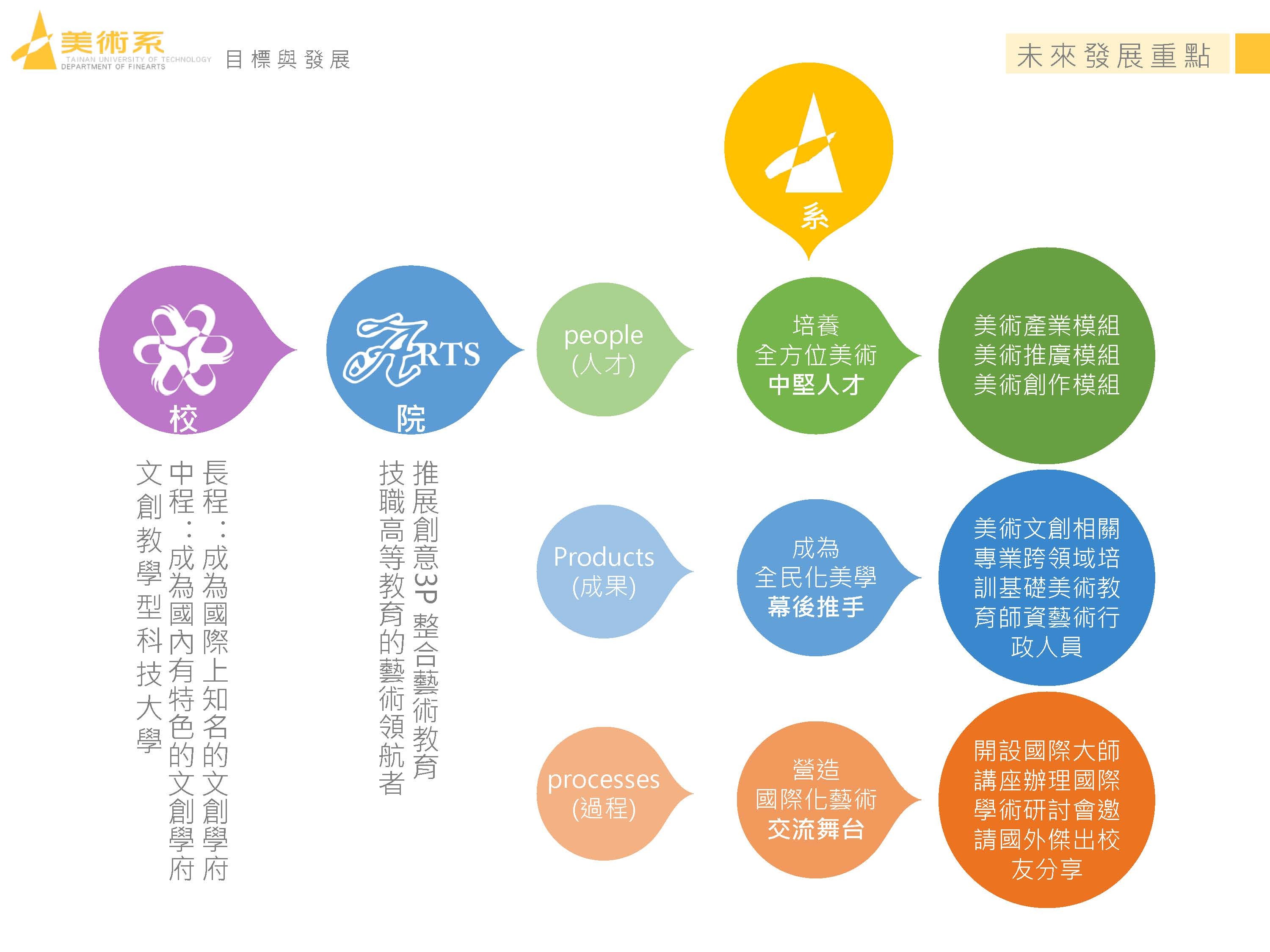
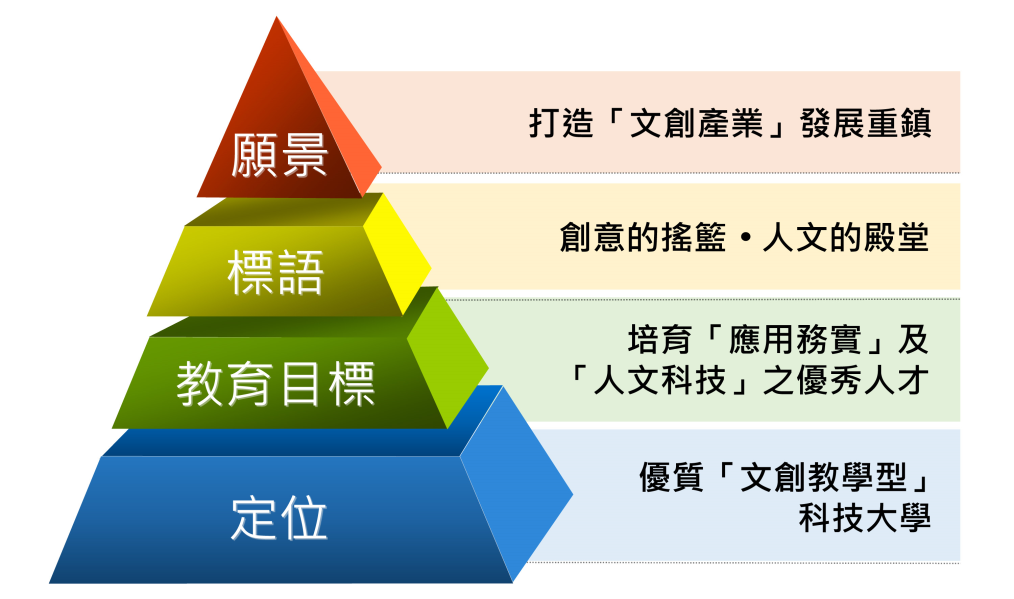
■ Preface Founded in 1964, the school has flourished under the leadership of successive boards of directors and principals. Since President Huang Zongcheng took charge of school affairs in the 108 academic year, he has spared no effort in promoting international affairs, shaping the school into a university of science and technology with an international outlook. At present, it has signed exchange and cooperation agreements with more than 60 foreign schools in 12 countries including Japan, South Korea, the United States, New Zealand, Australia, Mongolia, Canada, the United Kingdom, China, Malaysia, Singapore, and Thailand, and the number continues to increase. Our school is a solid foundation for talents in the cultural and creative industry, and has diversified in cultivating talents in related fields. Through the school development plan, we have established our school's vision, educational goals and positioning (as shown in the figure below), with "cultural creativity" as the core of development. And with the positioning of a high-quality "cultural and creative teaching-oriented" science and technology university, the whole school will devote its efforts to create unique school-running characteristics and build the school into a veritable cultural and creative institution. With the slogan of "Cradle of Creativity, Palace of Humanities", the school is a teaching-oriented university of science and technology, the only university of science and technology in Taiwan with a college of art. The newly completed "Central Cultural and Creative Workshop" at the end of 2021 will provide more Sufficient teaching resources make our school a high-quality, distinctive and competitive university. Such a unique background in humanities and arts is unique to other schools, especially the cross-collegiate integration and exchanges between various colleges, which naturally form cultural and creative It is the most representative cultural and creative university in the country. Starting from the 2011 academic year, the new principal, Dr. Yang Zhenghong, will lead the school to continue to take root and accumulate cultural cultivation to generate endless momentum. With the vision of building a "cultural and creative industry" development center, it will cultivate high-quality cultural and creative professionals for the country .
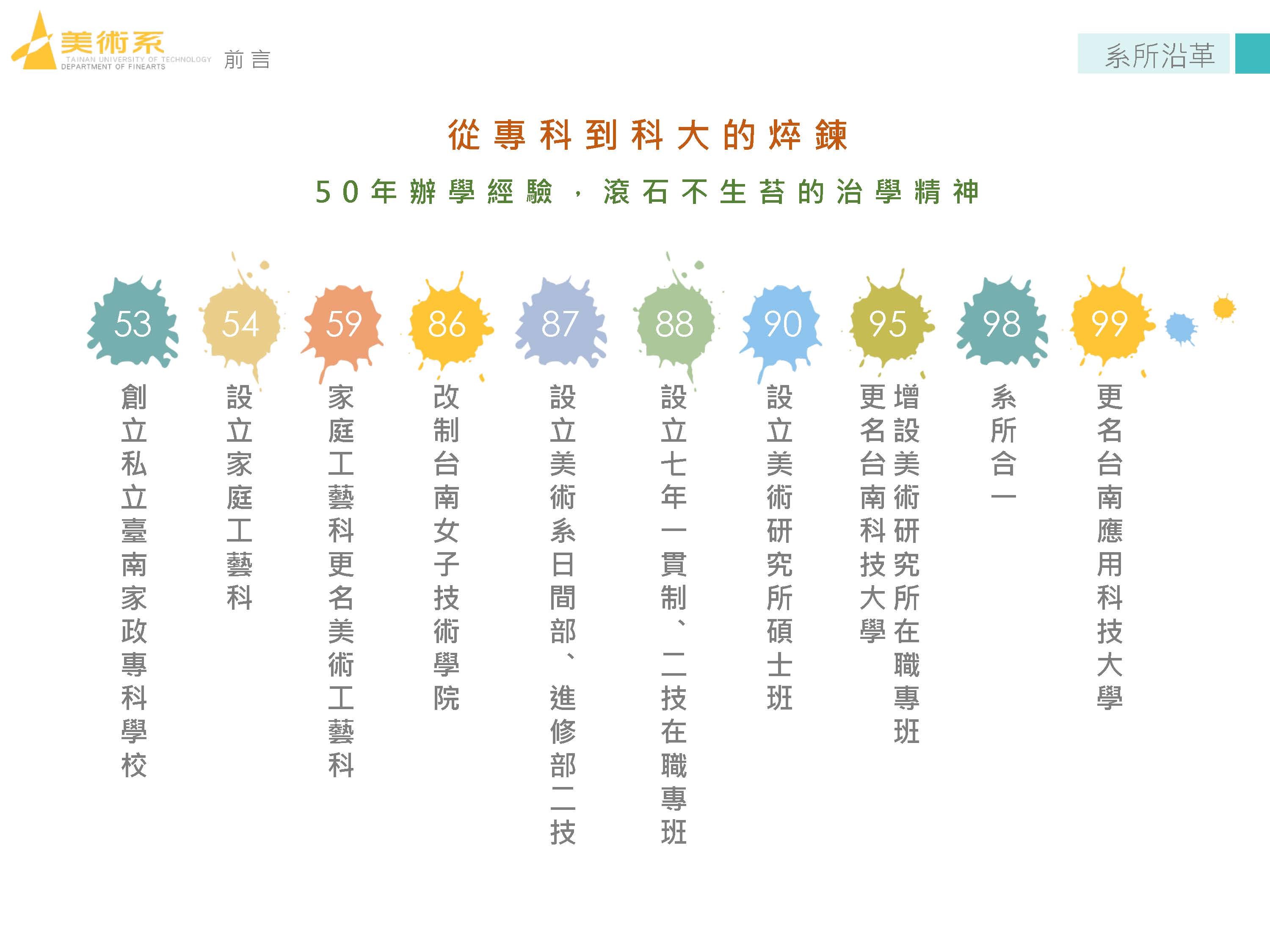
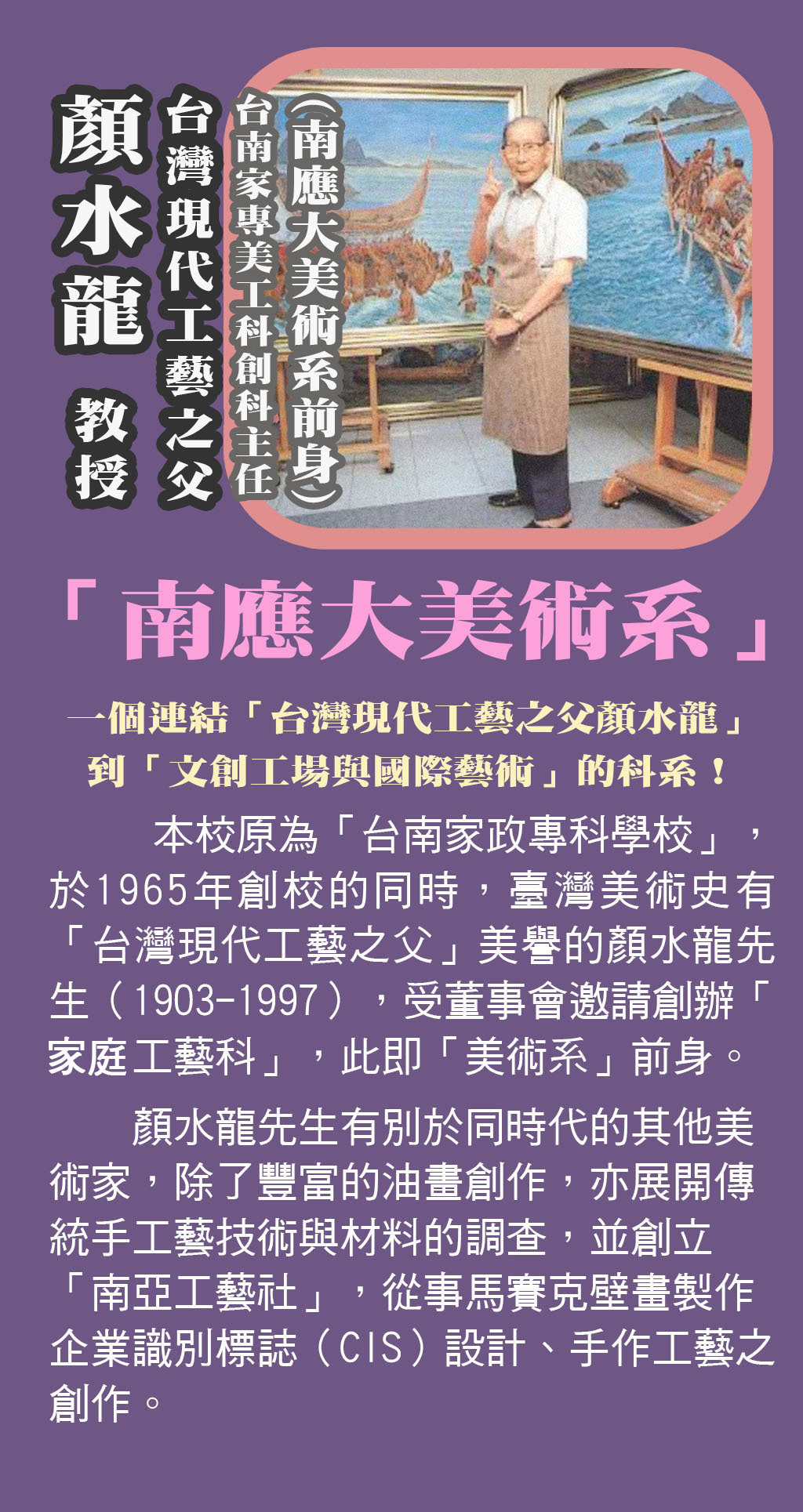
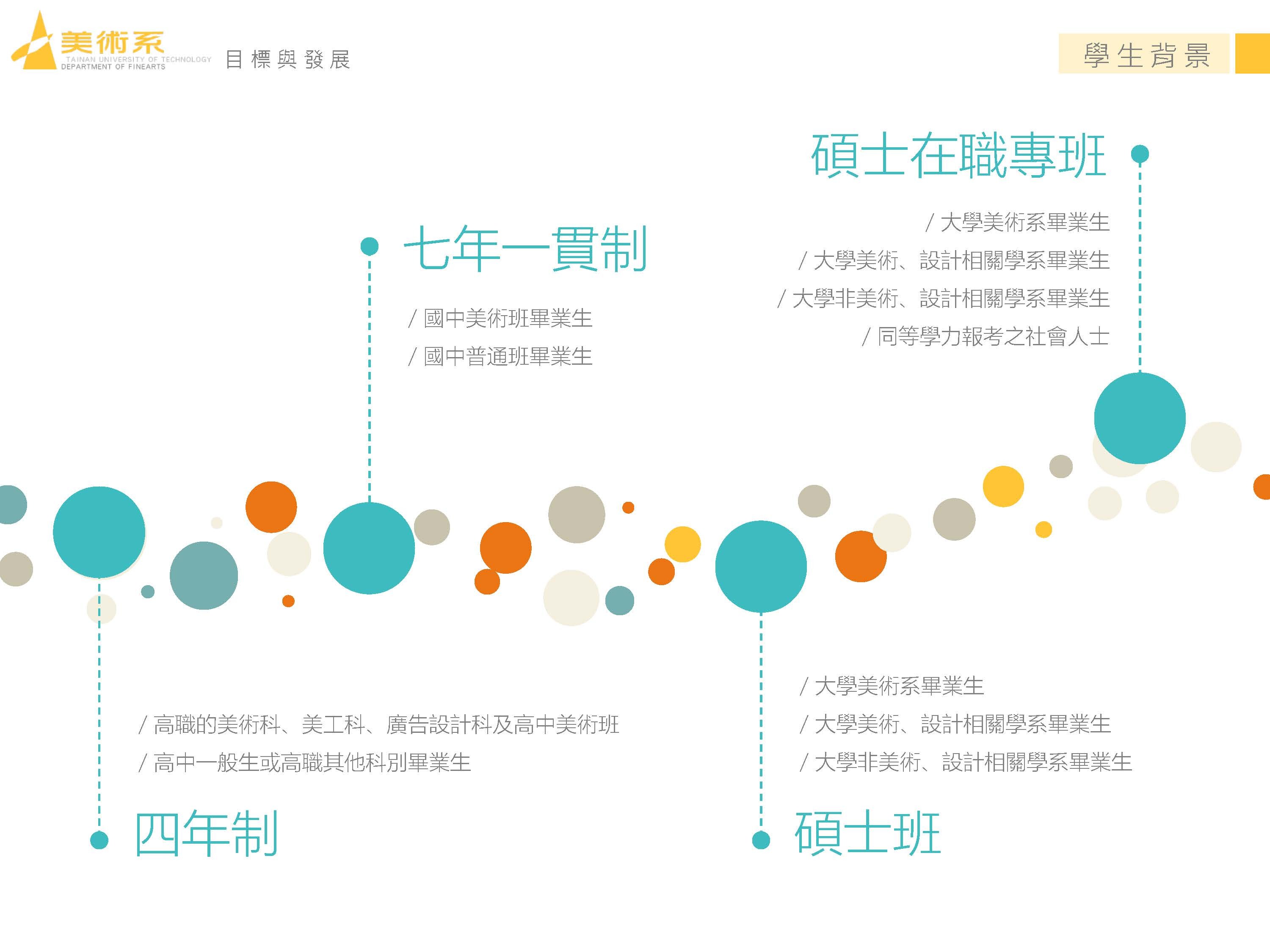
The department has been established for more than 50 years since the founding of the school, and has been chaired by Yan Shuilong, Dai Fengzhao, Su Shixiong, Hou Liren, Lin Shengliang, Lin Chengfa, Lin Rongbin, Li Chunyu, Xu Zigui, Zhong Suilan, Zhang Zhenhui, Zeng Junyi, and Huang Jinfu. And the teachers are committed to the promotion of departmental affairs, and have gone through the transformation of the three periods of junior colleges (art group of arts and crafts department), technical colleges and universities of science and technology (department of fine arts). All have been adjusted, and students' learning performance has also been improved with professional equipment, environmental construction, and continuous revision and expansion of teaching materials. The results are visible and have been well received by the society. At present, there are seven-year consistent, four-year, and master classes in the daytime department, and four-year, master's on-the-job special classes in the advanced education department. The number of students is about 1,200, and there are 30 full-time teachers and nearly 40 part-time teachers. Since 1997 (86 years of the Republic of China), my country's birth rate has been decreasing year by year, and it is facing the impact of university enrollment in 2016 (105 years of the Republic of China). Under the severe test of the number of children and the wide establishment of universities (there were 91 technical and vocational schools at the time of the evaluation, including 14 technical schools, 24 technical colleges and 53 universities of science and technology), passed the evaluation of the 101st academic year of the University of Science and Technology The chain allows the department to systematically examine the characteristics of students, teaching effectiveness, faculty structure, and career development, so that the development direction of department affairs is more determined, the goals are clearer, and we are confident that we can successfully overcome the challenges of future enrollment difficulties. |
|
The department has more than 40 years of experience in running schools. All previous department chairmen have deeply felt the importance of an educational concept that is in step with the times, just like the spirit of a rolling stone that never grows moss. Therefore, the development of the Department of Fine Arts has always been to cooperate with the national cultural construction, to meet the needs of local art and cultural activities talents, and to cultivate fine arts professionals; to establish partnerships with the industry at the same time, and to develop the student employment market as the target. In addition, the Printing Center was established, currently headed by director Huang Wenyong, and the former director, Professor Huang Yusheng, served as the art director. A training center for printing teaching, creation, and R&D personnel in southern Taiwan was established. Credit courses, work camps, and master lectures and exchange exhibitions were held. , to promote the art printing industry. In the 2016 academic year, it was approved to set up a bachelor's degree program in comics, hoping to bet on the energy from academia in the domestic comics industry, take the comics professional training courses as the axis, combine the existing relevant industry courses, cultivate first-class professional comics talents, and show the art in literature Create new value in the field (the 110 -year comics degree program was changed to the Department of Cartoons under the School of Design, and the Department of Fine Arts still offers courses related to comics for students to choose) . Following the above, we understand the central idea of flipped education. In addition to inheriting and implementing the concept of university professors’ independent academic research, according to the direction of graduates’ career development, the teachers in charge of the class will determine the appropriate teaching content according to the needs, and hold teaching seminars to exchange teaching from time to time. experience, and develop space equipment plans to meet teaching needs. After the overall development goal of the school has established an international trend, under the subsidy of the Teaching Excellence Program, we will actively invite foreign artists to be guests, hold international academic seminars, provide a learning environment with a global perspective, and look forward to promoting students to use the world as a stage. Aspirations are realized.
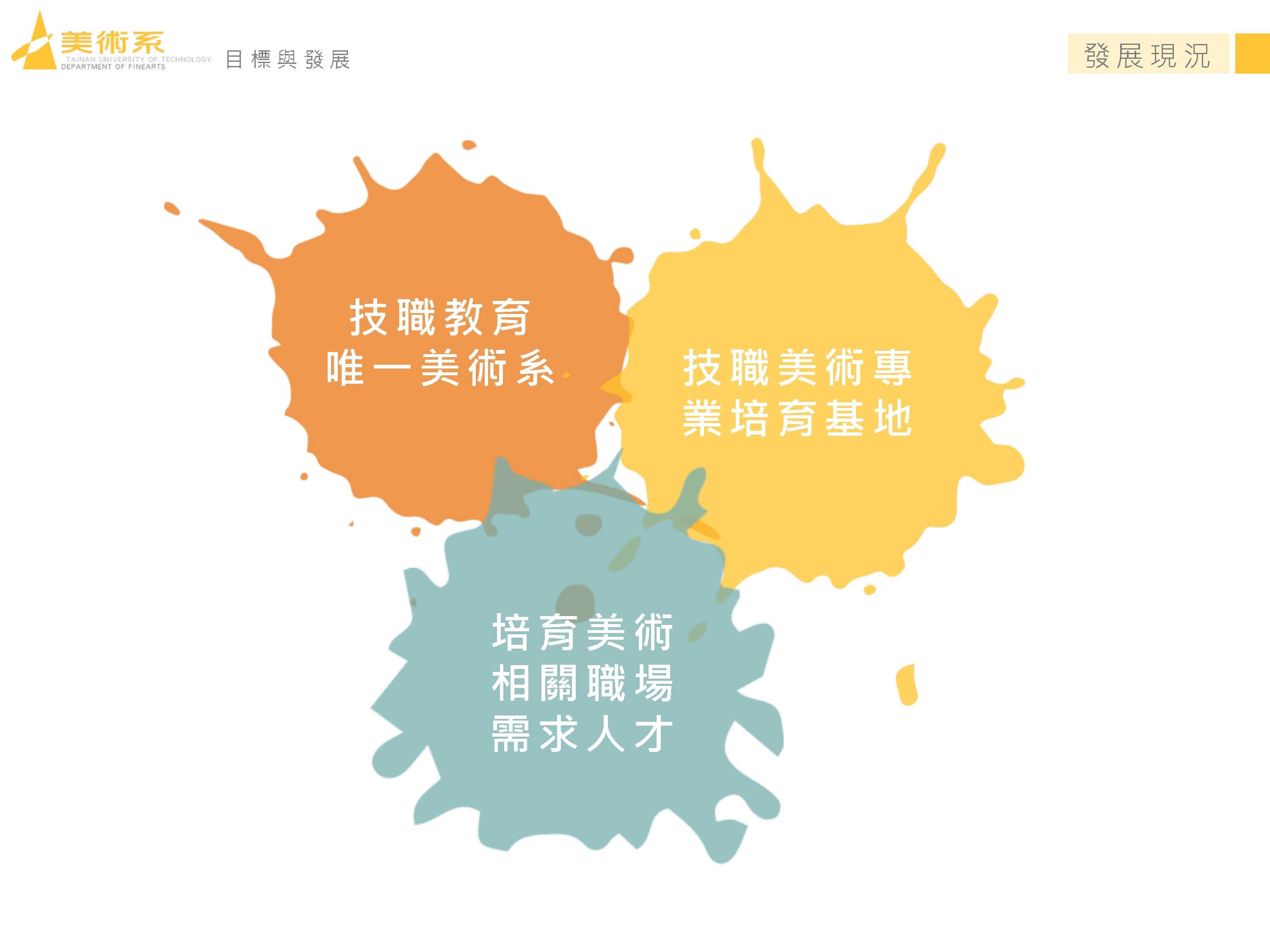
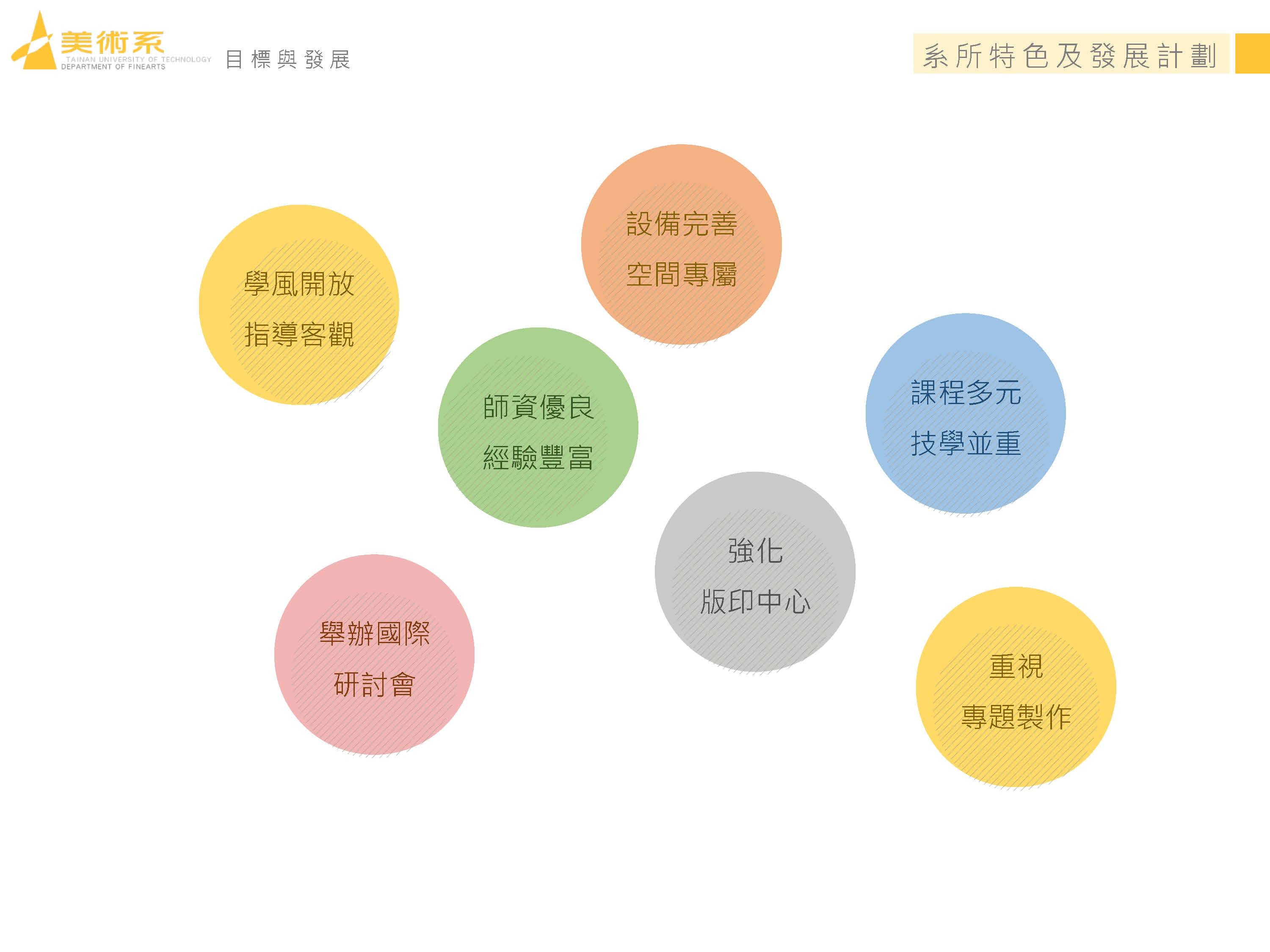
■ Department business development goals1. A professional training base for technical art, to cultivate talents in demand for art-related workplaces.
★Six advantages of the Fine Arts Department of Nanying University
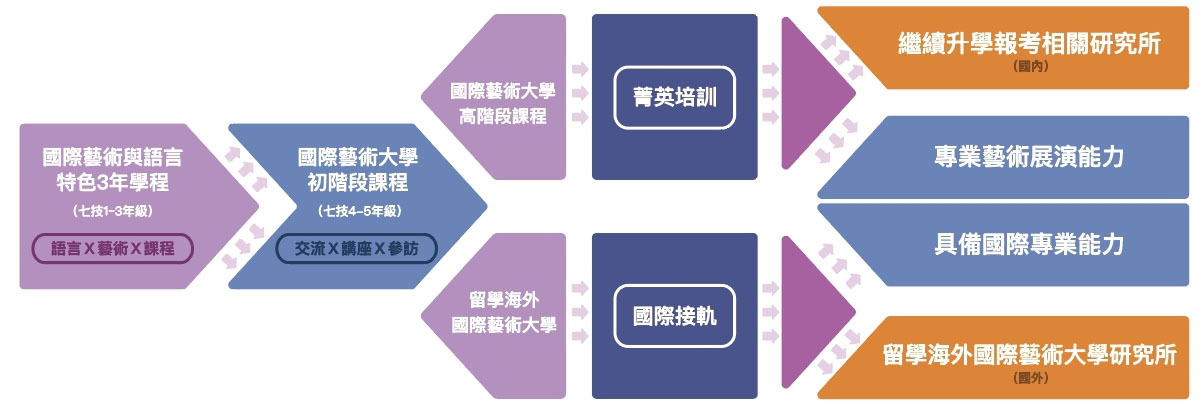
1. High-quality teaching staff and course equipment: the number and quality of 30 full-time professors and more than 30 part-time teachers surpass those of design and art related departments at home and abroad. In the field of digital technology, ceramics and plate printing equipment rank first in the country. 2. There are a lot of scholarships and grants: admission rewards and scholarships for freshmen, free accommodation for low-income students, on-campus work-study opportunities, many benefits of being a teaching assistant, and dedicated professors to guide students to participate in competitions to earn bonuses. 3. Enhancing the ability of taking education courses: high school vocational, junior high school, and preschool teacher training courses, with abundant places and learning resources, to train the new generation of outstanding educational talents to obtain teacher certificates. 4. Students have strong creativity and execution ability: the curriculum cooperates with the functional teaching concept of "school is a workshop" to cultivate students' creativity, art professional skills and employability. 5. International cross-field and locality: Based on the ancient cultural capital of Tainan, expand cultural and artistic activities to northern Taiwan and southern Taiwan. The department has long promoted international art and cross-field cultural exchange programs, and held international exhibitions and academics in the United States and Japan. Seminars, counseling students for overseas internships and employment, implementing programs such as "Learning from the Sea to Build Dreams" and "New Southward Learning to Build Dreams from the Sea", and counseling students to study in foreign research institutes. 6. The employment opportunities of department members are diverse: department members serve as university professors, middle school or studio talent class teachers, gallery, museum and art gallery staff, art and cultural activity curators, art designers, cultural and historical workers, illustrators, photographers, Director, director of ceramics, printing, sculpture, 3D printing and other media studios, public art creation and execution.
■ Execution strategy1. Give full play to the characteristics of art technical vocational education, so that students with artistic talents can be taught and taught at the right place. 2. Promote the three module courses of "art creation", "art industry" and "art promotion". 3. Advocate multi-learning and multi-angle teaching, and cultivate art professionals with independent thinking ability. 4. Encourage off-campus visits to course teaching, and learn about workplace practices. 5. Combining with local cultural characteristics, strengthen the production capacity of art services. 6. Set up workplace practice courses to integrate with industry functions and implement the spirit of technical and vocational education. 7. Pay attention to the growth of extracurricular learning, hold special lectures, academic seminars and competitions. 8. Invite international masters to be guests, stimulate the creative thinking of teachers and students, and broaden the horizons of international art. 9. Actively promote international affairs, carry out exchanges with relevant schools and departments overseas, and grasp the pulse of world art development.
■ Master Class - Course Introduction1. Compulsory courses for majors: art research methodology, introduction and writing of creative discourse, contemporary art research, art interdisciplinary topics 2. Major electives are divided into two areas: (1) artistic creation (2) theory and industry 3. Professional elective subjects: lectures by international masters, research on creative psychology, modern aesthetics, comprehensive media for painting, printmaking, ceramics, three-dimensional modeling, public art, environmental art, Western art history, painting theory, contemporary video, contemporary art curation and Seminar Topics, Visual Culture Research, Taiwan Art and Culture Topics, New Media and Technology Aesthetics Topics, Cultural and Creative Industry Research...etc. 4. Graduation thesis: After passing the master's thesis or graduation creation, you can get the master's degree of art
■Professional development characteristics of the master's class1. Integrate the two major cross-field thinking of art theory and industry, art creation 2. Cultivate the ability to independently plan exhibitions and plan operations 3. Diversified thinking and professional artistic creation ability 4. Possess international professional ability and international academic exchange development ■ Please click me for detailed information of master class
|
|
.jpg)